
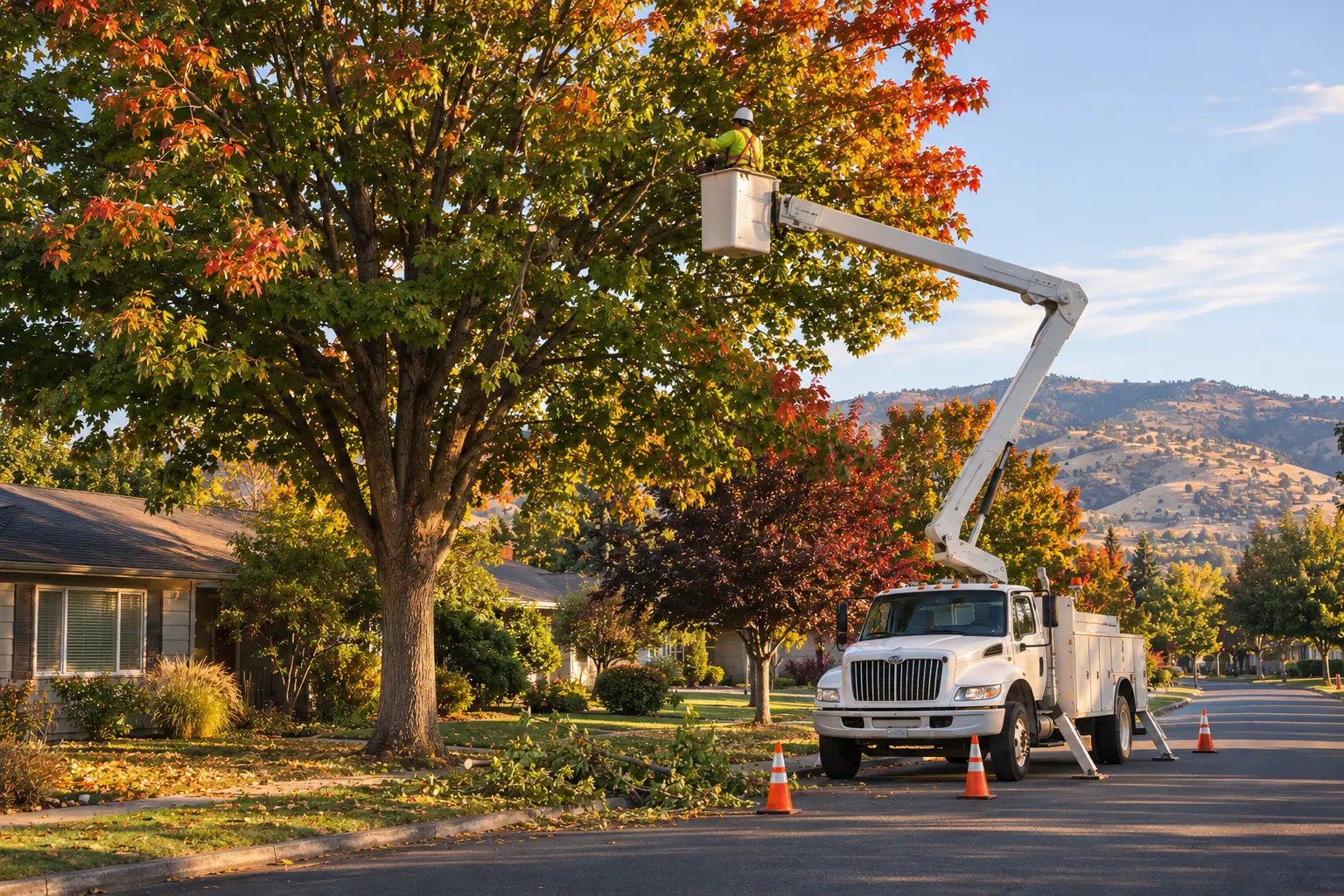
Homeowners who want tree service in Phoenix can call (541) 855-3179 at no cost and reach one independent company with an active Oregon CCB license. Say you are in Phoenix and ask if it covers your part of town. Health checks, pruning, removals and stump grinding are all fair to ask about. A price comes after someone has seen the tree. Ask whether that visit is free, which it usually is for routine work, and get the number on paper. Phoenix has its own development code and a fire history that still shows in many yards.
Trees that came through the 2020 fire
Many of the trees in Phoenix today either survived the Almeda Fire or were planted after it, and both kinds need a different kind of attention.
The fire started on the morning of September 8, 2020, and destroyed more than 2,600 homes between Ashland, Talent, Phoenix and Medford, Jefferson Public Radio reported a year later. It also burned a long stretch of the Bear Creek Greenway. Years on, a scorched tree can look fine from the street while the damaged side of the trunk slowly decays.
When a tree service looks at a fire survivor, these are the usual checks:
- Bark that is missing, loose or sunken on one side of the trunk.
- Dieback in the crown, especially limbs that leafed out after 2020 and then died.
- Fungus or soft wood at the base or in old wounds.
- A lean toward a rebuilt house that was not there before.
- Roots cut or buried during cleanup and rebuilding.
A tree that passes those checks may need only deadwood removal and some thinning. One that fails them may be a removal. Our tree care and health checks page explains what a health visit covers.
Trees Phoenix does not allow in a planter strip
Phoenix bans several kinds of trees from the public planting strip, and three of them are restricted anywhere in the city.
Section 3.3.4(F) of the Phoenix Land Development Code, as amended through Ordinance 1053 (effective March 19, 2026), lists them:
| Tree type | In a public planting strip | Elsewhere in Phoenix |
|---|---|---|
| Willow, cottonwood, poplar | Not allowed | Only on a site the City Council or its representative approves, so roots stay out of public sewers |
| Conifers | Not allowed | Not restricted by this section |
| Fruit trees and nut trees | Not allowed | Not restricted by this section |
| Ailanthus (tree of heaven) | Not allowed | Not restricted by this section |
| Bamboo | Not allowed | Not restricted by this section |
That list matters when you replant a burned lot. A fast-growing willow or poplar is tempting for quick shade, but in Phoenix it needs approval wherever it goes. Fruit trees belong in the back yard, and our fruit tree pruning page covers their care.
What the code asks of new street trees
Phoenix requires street trees on developments that go through land division or site design review, and the standards in section 3.3.4 say how they are chosen and cared for.
Trees go in at a minimum of 1.5 inches in caliper, usually no more than 30 feet apart, and a development must use at least two species so one disease cannot strip a whole street. The code calls for low-growing trees under utility wires and trees that can be limbed up where drivers need to see. The developer plants after the house is finished and handles pruning, watering, fertilizing and replacement for the first two years.
After those two years, the young tree's shape is set by how it is pruned. Light structural pruning in the early years, choosing one main leader and spacing the main limbs, costs far less than fixing a badly formed tree later.
Tree rules on lots being built or divided
Anyone building on, remodeling or dividing a Phoenix lot should know that the code treats trees with a trunk at least 6 inches thick as significant vegetation.
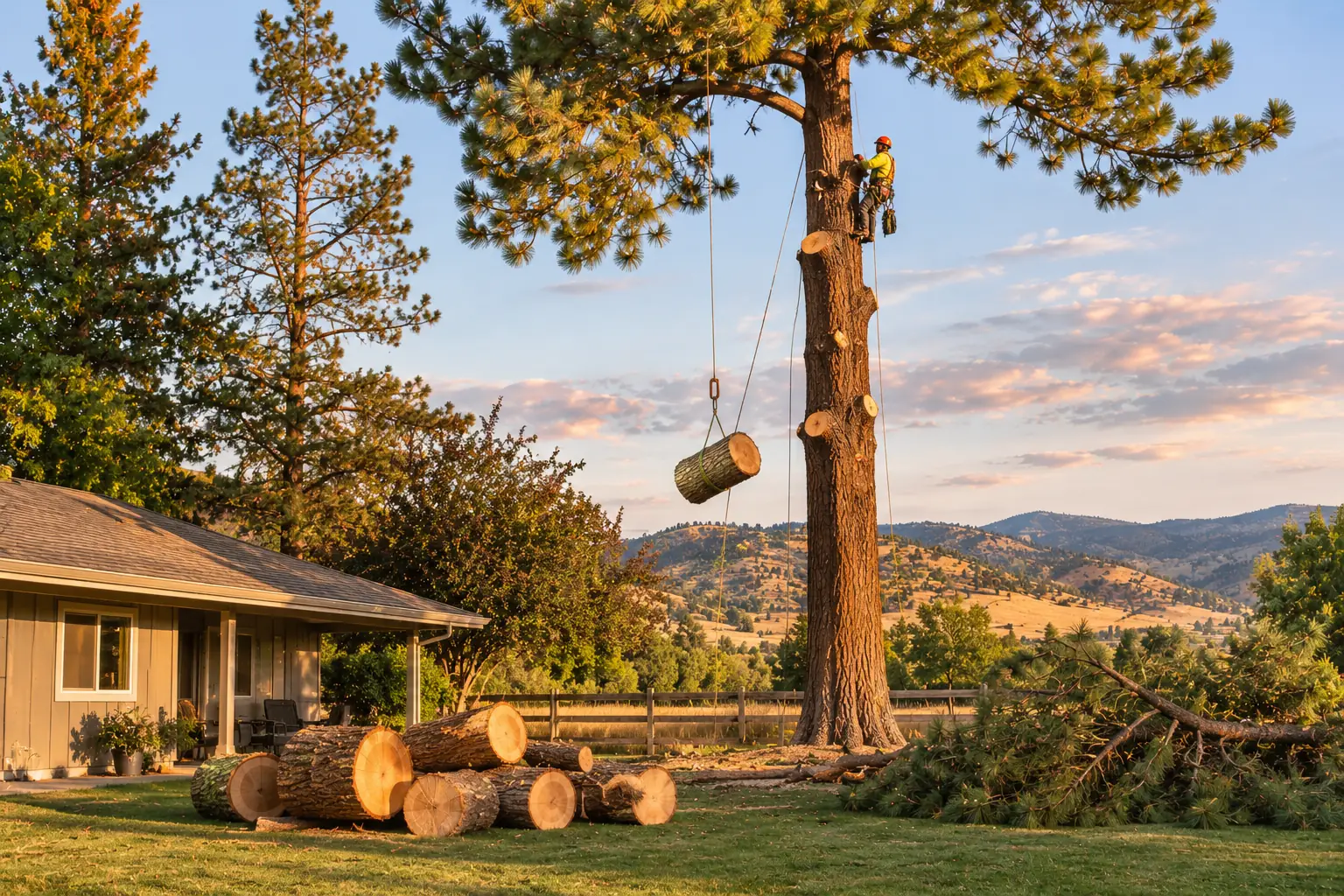
Under section 3.3.2, the trunk is measured at 4 feet, the trees are mapped on the site plan and kept where practicable, and heavy equipment stays out of the root zone below the branches without city approval. Plants that OSU Extension lists as non-native invasive species in Jackson County are not protected. A dead, diseased or hazardous tree may be taken out after a report from a certified arborist or a similar professional on its condition and on any treatment that might save it. If a city official finds that a tree immediately endangers life or safety, it can be cut without land use approval, with written notice from the official inside a week.
For questions about your lot, call the city's Community and Economic Development Department at 541-535-2050, or City Hall at 541-535-1955, as listed on the Planning page.
Work near the service wire to your house
Tree work near the wire that runs from the pole to your house needs the utility's help before a crew starts.
Pacific Power's tree page says never to prune limbs or remove trees near power lines yourself, and it offers a free temporary service disconnect so work near your service line can be done safely. Call 1-888-221-7070 to set that up, and tell the tree service the date. Before planting a replacement tree, call 811 at least 48 hours ahead to have buried lines marked.
Branches and brush
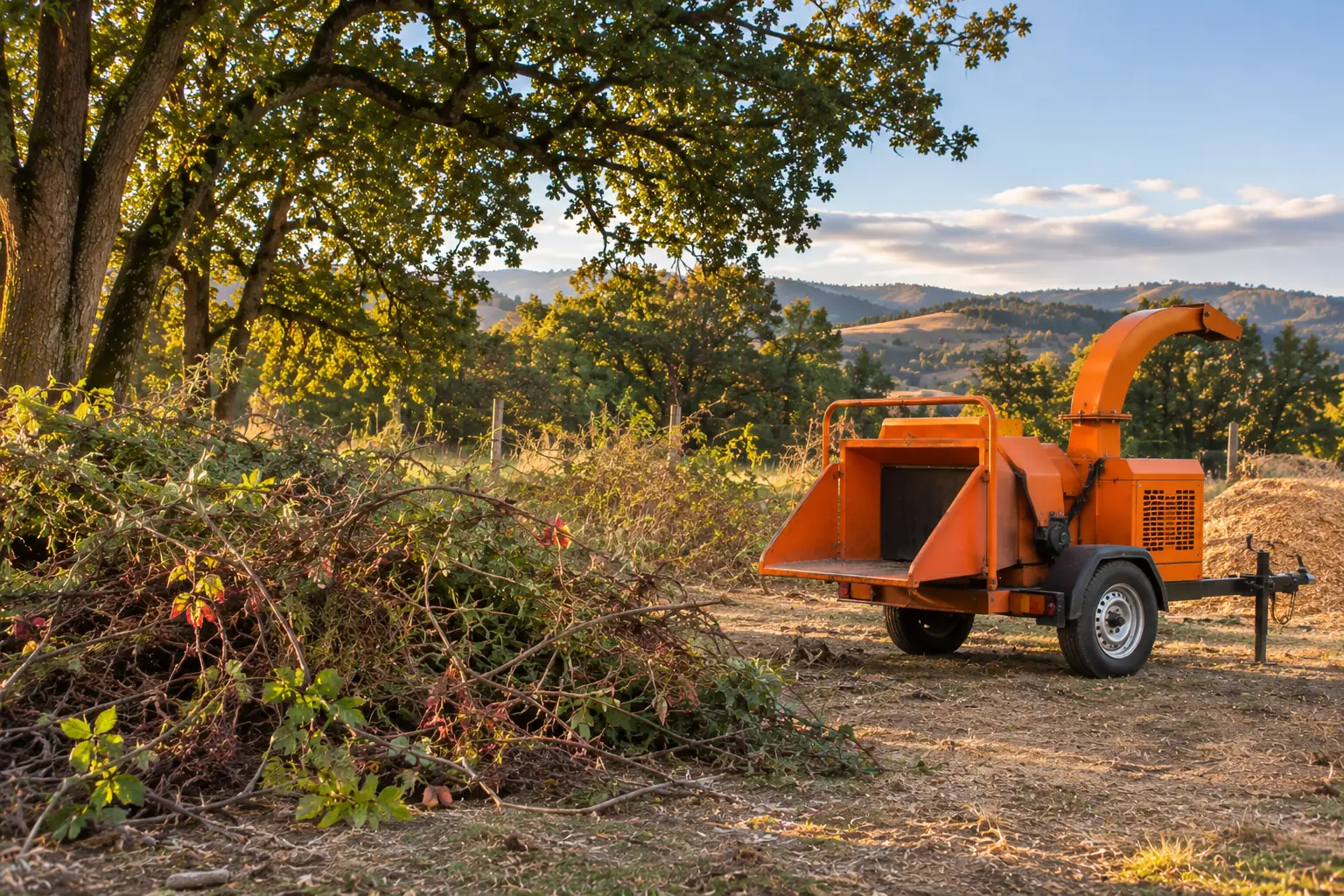
Burning yard debris at home is not an option inside Phoenix city limits, according to Jackson County's open burning page. Ask whether chipping and hauling are in the estimate. For overgrown blackberry or scrub along a back fence, see brush removal.
Nearby pages
Prices depend on the tree, the access and how much cleanup you want, and the company's written estimate is the number to rely on. The tree service cost guide has sourced ranges. Talent, just south on Highway 99, has its own page: tree service in Talent. Head back to the home page for every service and town.
Frequently asked questions
Should a tree that was scorched in the Almeda Fire come down?
It depends on the tree. A scorched tree can recover with pruning, or it can rot slowly from the burned side. Have a tree service check the bark, the crown and the base before you decide.
Can I plant a fruit tree in my Phoenix planter strip?
No. Section 3.3.4(F) of the Land Development Code bars fruit and nut trees from public planting strips, along with conifers, willow, cottonwood, poplar, ailanthus and bamboo.
Can I plant a willow or poplar in my Phoenix back yard?
Only on a site the City Council or its representative approves as one where the roots will not interfere with a public sewer. The same rule covers cottonwood.
Who do I call before a tree crew works near my power line in Phoenix?
Pacific Power at 1-888-221-7070. It offers a free temporary service disconnect so a crew can work near the line to your house safely.